With the global online education market projected to reach around $342 billion by 2025 and growing at roughly 15–16% annually through 2029, there’s never been a better time to invest in online learning.
But with hundreds of platforms competing for your attention, finding the right one can feel overwhelming.
After spending weeks researching and testing the leading online learning platforms, I’ve shortlisted our top five recommendations for 2026.
Coursera is our number one choice, offering recognized university-backed credentials, a vast course library, and the flexibility to audit many courses for free — making it ideal for career changers and lifelong learners alike.
| Platform | Rating | Starting Price | Best For | |
|---|---|---|---|---|
| 1 | Coursera | 4.7 | Free (audit) / $49+ per course | Best for degrees & career changers |
| 2 | edX | 4.5 | Free (audit) / $50+ per certificate | Best for academic learning |
| 3 | Khan Academy | 4.6 | Free | Best free learning platform |
| 4 | Skillshare | 4.2 | $13.99/month (annual) | Best for creative skills |
| 5 | Mighty Networks | 4.0 | $41/month | Best for community learning |
Our Top 5 Online Learning Platforms
- Coursera – Best for degrees and career changers
- edX – Best for academic learning
- Khan Academy – Best free learning platform
- Skillshare – Best for creative skills
- Mighty Networks – Best for community learning
#1. Coursera: Best for Degrees & Career Changers
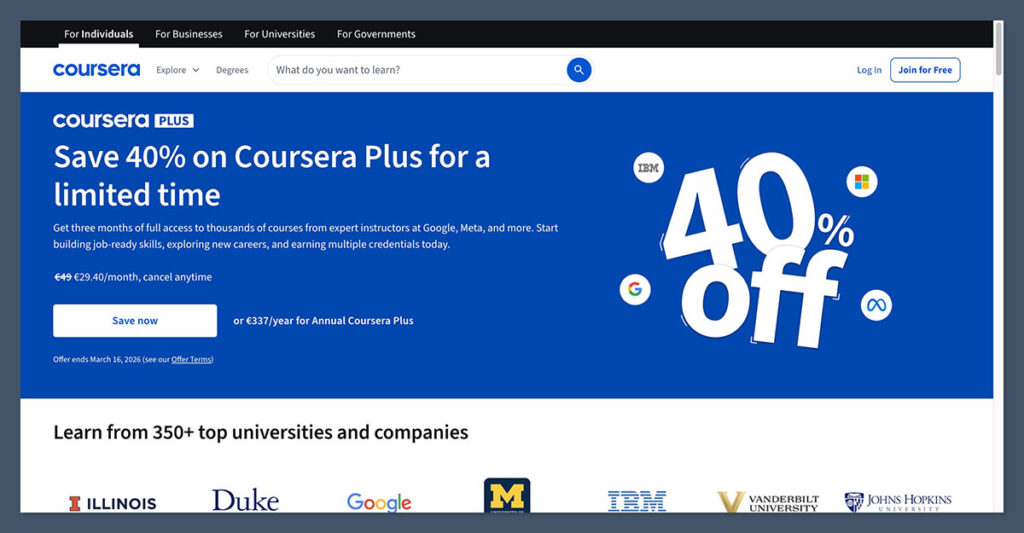
💰 Starting price: Free to audit / $49+ per course / Coursera Plus from $59/month
🎓 Credential types: Certificates, Professional Certificates, MicroMasters, Full Degrees
🏛️ Partners: 300+ universities and companies including Stanford, Yale, Google, and IBM
Coursera is the best online learning platform I’ve tested, and it earns the top spot in our rankings for 2025.
After exploring its massive library of university and industry-backed courses, I can see why it remains the go-to choice for anyone serious about career advancement or earning a recognized credential.
The platform partners with some of the world’s most prestigious institutions, which gives its certificates real weight with employers.
✔️ Pros
- Recognized certificates and full degrees from top universities
- Many courses can be audited for free
- Strong professional certificate programs (Google, Meta, IBM)
- AI-driven course recommendations and adaptive learning paths
❌ Cons
- Degrees and certificate programs can be expensive
- More structured and time-intensive than casual learning platforms
- Free audit track has limited access to graded assignments
- Some courses feel more like recorded lectures than interactive experiences
What really impressed me about Coursera is the depth of its professional certificate programs. Programs from Google, Meta, and IBM are designed to take you from zero experience to job-ready in fields like data analytics, UX design, and cybersecurity — often in under six months.
And because many employers now recognize these certificates, they can genuinely help you land a new role or pivot your career.
Coursera Plus, the subscription option, gives you unlimited access to most courses and certificates for a flat monthly or annual fee.
For active learners, this is excellent value compared to buying courses individually. One thing to bear in mind though, is that full degree programs are priced separately and can run into the thousands — though they’re still significantly cheaper than on-campus alternatives.
How Much Does Coursera Cost?
- Individual courses range from free (audit) to $49–$99 for a certificate
- Coursera Plus costs $59/month or $399/year for unlimited access
- Professional certificate programs typically cost $39–$49/month
- Full degree programs range from $9,000 to $45,000+
Bottom Line: Should You Use Coursera?
Coursera offers the strongest combination of academic credibility and practical career preparation.
It’s a real powerhouse for anyone looking to earn a recognized credential, switch careers, or upskill in a structured way. The free audit options make it accessible, while the paid tracks deliver genuine career value.
Coursera is suitable for:
- Career changers who need recognized credentials
- Professionals looking to upskill in tech, business, or data
- Learners who want university-quality education at a fraction of the cost
Coursera isn’t suitable for:
- Casual learners who don’t need certificates or structured paths
- Creative skills like illustration, video editing, or photography
- Users who prefer community-driven, peer-to-peer learning
#2. edX: Best for Academic Learning
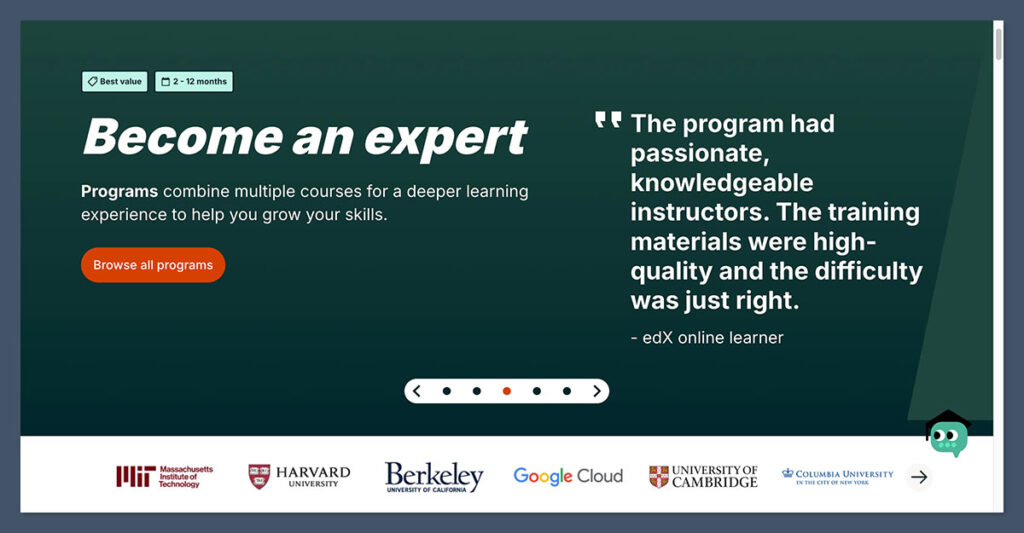
💰 Starting price: Free to audit / $50+ per verified certificate
🎓 Credential types: Verified Certificates, MicroMasters, Professional Certificates, Degrees
🏛️ Partners: Harvard, MIT, Berkeley, and 250+ institutions worldwide
According to our research, edX remains one of the strongest platforms for academic-style online learning in 2025.
Founded by Harvard and MIT, edX has a pedigree that few competitors can match. From my testing, the platform excels at delivering rigorous, university-level content across a wide range of subjects — from computer science and engineering to humanities and business.
✔️ Pros
- Strong university partners (Harvard, MIT, Berkeley)
- Many free audit options across thousands of courses
- MicroMasters programs that can count toward full degrees
- Rigorous, academic-quality content
❌ Cons
- Free audit track doesn’t include graded work or certificates
- Interface can feel more utilitarian than other platforms
- Some programs have strict enrollment windows
- Less focus on practical, hands-on skill-building
Where edX really shines is in its MicroMasters and MicroBachelors programs — stackable, credit-bearing certificates that can count toward a full degree at participating universities.
This is a genuinely innovative approach to higher education, and it’s one of the key trends shaping online learning in 2025.
If you’re considering a master’s degree but aren’t ready to commit to a full program, starting with a MicroMasters lets you test the waters while earning credits you can use later.
The learning experience on edX tends to be more academic and structured than platforms like Skillshare or Khan Academy.
You’ll find discussion forums, weekly deadlines, and graded assignments that mirror a traditional university course. This is great for discipline and depth, but it does mean edX requires more commitment than a casual browse-and-learn platform.
How Much Does edX Cost?
- Most courses are free to audit (without certificate or graded work)
- Verified certificates typically cost $50–$300 per course
- MicroMasters programs range from $600 to $1,500
- Full degree programs are priced individually by the partner university
Bottom Line: Should You Use edX?
edX’s academic rigor and stackable credential model make it ideal for learners who want a university-level experience without the university price tag.
The platform is especially strong for technical and STEM subjects, and its MicroMasters pathway is one of the most forward-thinking approaches to online education available today.
edX is suitable for:
- Learners who want academic depth and rigor
- Students exploring graduate-level subjects before committing to a degree
- Professionals in STEM, business, and social sciences
edX isn’t suitable for:
- Users who prefer a casual, self-paced learning style
- Creatives looking for project-based, portfolio-building courses
- Learners who want a polished, app-like user experience
#3. Khan Academy: Best Free Learning Platform
💰 Starting price: Completely free
🎓 Credential types: Progress tracking (no formal certificates)
🏛️ Focus: K–12 subjects, test prep, foundational college-level courses
Khan Academy is our expert recommendation for anyone who wants high-quality learning without spending a single penny.
As a nonprofit, Khan Academy offers its entire library of courses and exercises for free — no subscriptions, no hidden fees, no paywalls. This makes it an incredibly accessible resource for students, parents, and anyone looking to build or refresh foundational knowledge.
✔️ Pros
- Completely free with no paywalls or subscriptions
- Strong K–12 curriculum, especially in math and science
- AI-powered tutor (Khanmigo) for personalized help
- Trusted globally by students, teachers, and parents
❌ Cons
- Limited advanced professional or niche content
- No formal certificates or credentials for career use
- Content style is more educational than engaging or cinematic
- Less suitable for adults seeking career-specific skills
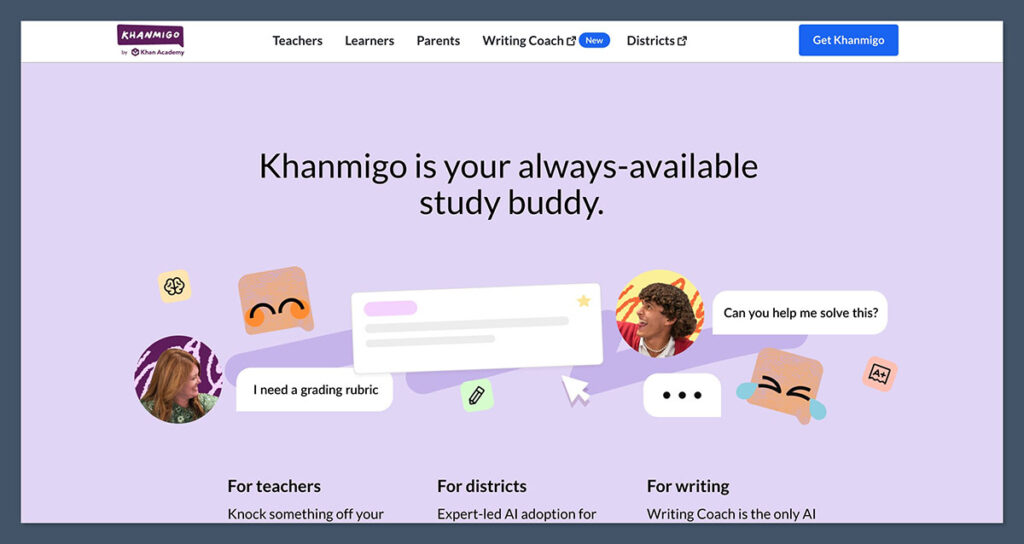
Khan Academy has been stepping up its game with the introduction of Khanmigo, an AI-powered tutoring assistant built in partnership with OpenAI. Khanmigo doesn’t just give you answers — it guides you through problems using the Socratic method, asking questions to help you arrive at solutions on your own.
This is a meaningful upgrade over the traditional “watch a video, do some exercises” model, and it represents one of the most promising applications of AI in education right now.
The platform’s strength lies in its K–12 curriculum, where it’s arguably unmatched. The math courses in particular are outstanding, with structured learning paths that take students from basic arithmetic through to AP-level calculus.
Test prep for the SAT, LSAT, and MCAT is another strong suit. That said, if you’re an adult looking for career-specific training or professional development, you’ll want to look at Coursera or Skillshare instead — Khan Academy’s content skews younger and more foundational.
How Much Does Khan Academy Cost?
- Everything is free — all courses, exercises, and learning tools
- Khanmigo (AI tutor) is available for a modest subscription fee for individual learners
- School and district plans for Khanmigo are also available
Bottom Line: Should You Use Khan Academy?
Khan Academy is an extraordinary resource — and the fact that it’s completely free makes it one of the most important educational tools on the internet.
For students, parents, and anyone brushing up on fundamentals, it’s an easy recommendation. Just don’t expect it to replace a career-focused platform.
Khan Academy is suitable for:
- Students looking for free, high-quality K–12 education
- Parents who want to supplement their child’s learning
- Adults refreshing foundational math, science, or economics knowledge
Khan Academy isn’t suitable for:
- Professionals seeking career-specific upskilling
- Learners who need recognized certificates or credentials
- Users looking for advanced or niche topics
#4. Skillshare: Best for Creative Skills
💰 Starting price: $13.99/month (annual plan)
🎓 Credential types: None (project-based, no formal certificates)
🎨 Focus: Design, illustration, photography, writing, video, freelancing
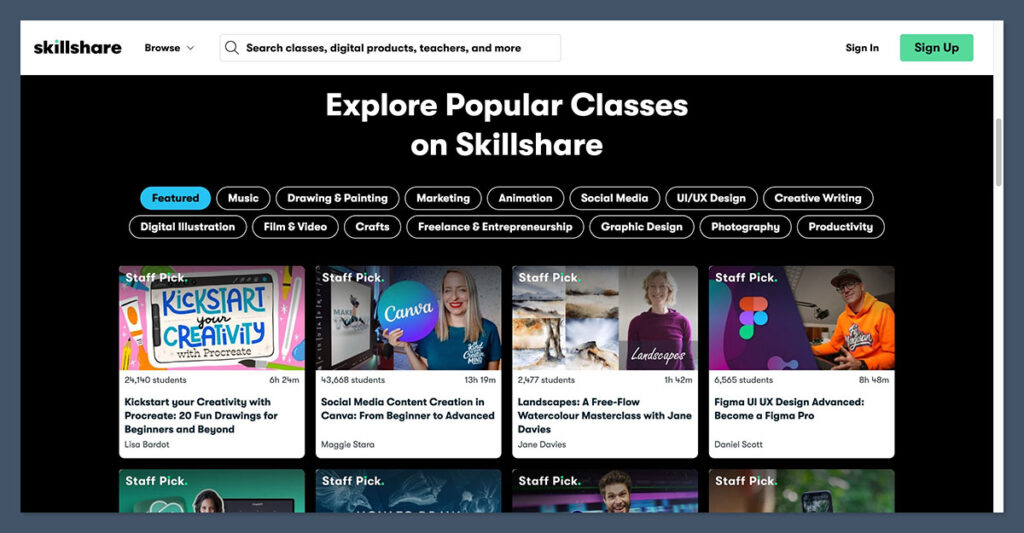
If you want to learn creative and practical skills, Skillshare is the best platform I’ve tested for that purpose. Its project-based approach sets it apart from the lecture-heavy style of Coursera or edX — here, you learn by actually making things.
The platform is especially strong for designers, illustrators, content creators, and anyone looking to pick up a creative side skill.
✔️ Pros
- Project-based classes that encourage hands-on learning
- Strong in creative niches (design, illustration, photography, writing)
- Good discovery experience for curious, exploration-minded learners
- Affordable subscription with access to the full catalog
❌ Cons
- No formal certificates or recognized credentials
- No university partners or academic backing
- Quality varies — anyone can teach on the platform
- Less effective for structured, career-track learning
What I found most appealing about Skillshare is the community and project-sharing aspect. After each class, you’re encouraged to complete a project and share it with the class community.
This creates a feedback loop that keeps you motivated and helps you actually retain what you’ve learned. It’s a very different vibe from passively watching lecture videos, and for creative subjects, it works remarkably well.
The subscription model gives you access to the entire catalog, which is great for “curious learners” who like to browse across topics — you might start with a watercolor class and end up learning about freelance pricing strategy.
However, because anyone can create and upload a class, quality isn’t as consistent as on curated platforms. You’ll want to pay attention to reviews and class lengths before committing your time.
How Much Does Skillshare Cost?
- Annual plan: $13.99/month (billed yearly)
- Monthly plan available at a higher rate
- Free trial available for new users
- Team plans are available for businesses
Bottom Line: Should You Use Skillshare?
Skillshare is the ideal platform for creative exploration and hands-on skill-building. Its project-based approach makes learning active rather than passive, and the subscription gives you freedom to explore widely.
Just don’t come here expecting formal certificates or career-track credentials.
Skillshare is suitable for:
- Designers, illustrators, and content creators
- Curious learners who want to explore a variety of creative topics
- Anyone who prefers learning by doing over watching lectures
Skillshare isn’t suitable for:
- Users who need recognized, career-boosting certificates
- Learners looking for in-depth academic or technical content
- Professionals who need structured, sequential learning paths
#5. Mighty Networks: Best for Community Learning
💰 Starting price: $41/month (billed annually)
🎓 Credential types: Platform-issued certificates (community-based)
👥 Focus: Cohort-based courses, memberships, community-first education
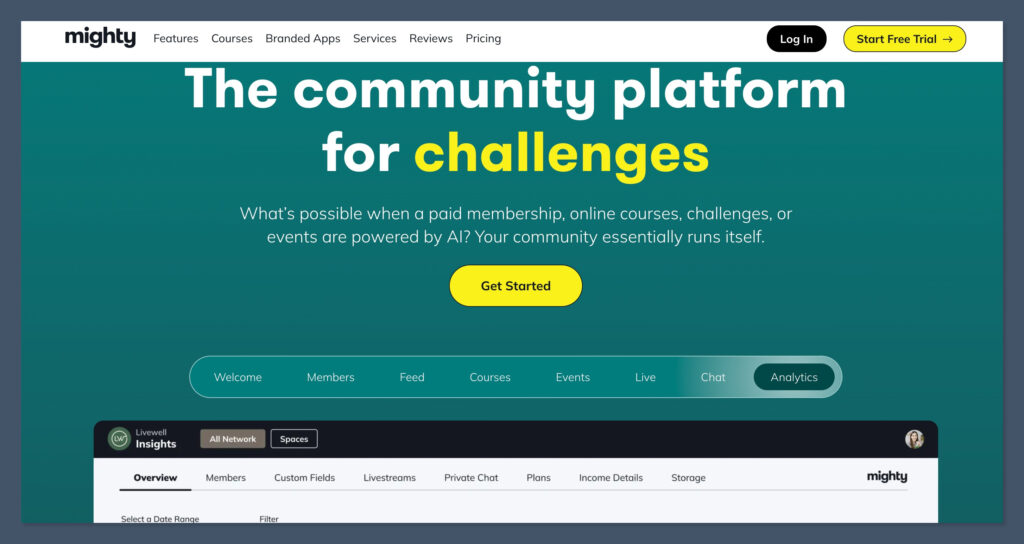
Our research team recommends Mighty Networks if you’re looking for a learning experience that puts community at the center.
Unlike traditional platforms where you learn in isolation, Mighty Networks is built around cohort-based courses, peer discussion, and group accountability. It’s a fundamentally different approach — and for the right learner, it can be far more effective than solitary self-paced study.
✔️ Pros
- Community-first design with built-in discussion and peer learning
- Strong for cohort-based and membership-style courses
- Ideal for learning that benefits from group interaction
- Growing catalog of courses from independent educators and experts
❌ Cons
- Course-building features less specialized than dedicated LMS tools
- Smaller brand recognition compared to Coursera or edX
- Quality depends heavily on the individual community and instructor
- Not ideal if you prefer anonymous, self-paced learning
When I tested Mighty Networks, what stood out was how the platform blurs the line between taking a course and joining a community.
You’re not just watching videos — you’re participating in discussions, completing challenges alongside peers, and building relationships with people who share your learning goals.
For topics where motivation and accountability matter (think: fitness, leadership development, creative entrepreneurship), this social layer can be a game-changer.
Mighty Networks is also a popular choice for course creators and coaches who want to build their own learning communities. The platform bundles community management, course hosting, and membership tools into one place.
This means you’ll find a wide variety of independent educators offering niche courses you won’t find on the big MOOCs — but it also means quality is less standardized, so you’ll want to vet each community before committing.
How Much Does Mighty Networks Cost?
- Joining a community: Free to premium, depending on the host
- Creating your own community starts at $41/month (billed annually)
- Higher-tier plans unlock advanced features like live events and branded apps
Bottom Line: Should You Use Mighty Networks?
Mighty Networks is best for learners who thrive in group settings and want more than just video content. If community, accountability, and peer interaction are important to you, this platform delivers something the traditional MOOCs can’t match.
Mighty Networks is suitable for:
- Learners who want cohort-based, community-driven courses
- People who value peer support and group accountability
- Coaches and educators building their own learning communities
Mighty Networks isn’t suitable for:
- Users who prefer anonymous, self-paced study
- Learners who need university-recognized certificates
- People looking for a massive catalog of on-demand courses
How To Choose the Right Online Learning Platform
Whether you’re learning something new for the first time or switching from a platform that isn’t working for you, it helps to know what to look for.
While we can help you compare platforms, you need to figure out your own priorities and must-haves, and identify what you can live without.
Below, I’ve put together a checklist of key factors to consider when researching or trialing an online learning platform:
- Your learning goals: Are you looking to earn a degree, pick up a new skill, or explore a hobby? Your goal should determine your platform — Coursera for credentials, Skillshare for creative exploration, Khan Academy for foundational knowledge.
- Credential value: Do you need a certificate that employers will recognize? Coursera and edX offer the strongest credentials. Skillshare and Khan Academy don’t offer formal certificates at all.
- Learning style: Do you prefer structured, deadline-driven courses (Coursera, edX) or flexible, self-paced browsing (Skillshare, Khan Academy)? Do you learn best in a community (Mighty Networks)?
- Budget: Khan Academy is completely free. Skillshare is affordable on a subscription. Coursera and edX offer free audit tracks but charge for certificates. Mighty Networks pricing depends on the individual community.
- Content quality: University-backed platforms (Coursera, edX) guarantee a certain level of rigor. Marketplace and community platforms (Skillshare, Mighty Networks) vary more in quality.
- AI and personalization: AI-powered learning paths and tutoring are becoming standard. Khan Academy’s Khanmigo and Coursera’s adaptive recommendations are leading examples.
- Mobile experience: If you want to learn on the go, check that the platform has a solid mobile app. Mobile-first learning is one of the biggest growth drivers in online education, especially in Asia-Pacific markets.
- Community and support: Some learners thrive with peer interaction and discussion forums. Others prefer solo study. Make sure the platform matches your preference.
Key Takeaways
- Coursera is our top-rated online learning platform for 2025
- Pricing ranges from completely free (Khan Academy) to $41+/month for community platforms
- AI-powered personalization is transforming how all five platforms deliver content
- Micro-credentials and stackable certificates are increasingly popular for career advancement
- The MOOC market alone was valued at roughly $26 billion in 2024, with a forecast CAGR of about 39% through 2034
Key Trends Shaping Online Learning in 2025
The online learning landscape is evolving rapidly. Here are the biggest trends influencing which platforms are worth your time — and your money — in 2025:
AI-driven personalization is no longer a nice-to-have — it’s becoming the standard. Platforms are using adaptive learning paths, content recommendations, and automated assessment to tailor the experience to each learner. Khan Academy’s Khanmigo is one of the most visible examples, but Coursera and others are integrating AI across the board.
Micro-credentials and stackable learning are reshaping how people think about education. Short, credit-bearing certificates that stack toward full degrees are increasingly popular on Coursera and edX. This “learn as you go” model is particularly appealing for working professionals who can’t commit to a multi-year program all at once.
Mobile-first and bite-sized formats are driving growth, particularly in the Asia-Pacific region. With North America currently accounting for about 36% of platform revenue and Asia-Pacific growing rapidly, the global appetite for flexible, on-the-go learning is enormous.
Community-based learning is gaining ground as platforms recognize that peer interaction and group accountability improve engagement and completion rates. Mighty Networks and similar platforms are leaning into cohorts, discussions, and social learning features.
Summary
Our research has determined the top five online learning platforms for 2025, and Coursera is the best platform for serious, career-oriented learning.
Its combination of university credibility, professional certificates, and flexible pricing makes it a real powerhouse for learners at any stage.
Each platform has its strengths — and weaknesses — so I know Coursera won’t be the right fit for everyone.
If you’re unsure of where to start, take advantage of free audit tracks, free trials, and Khan Academy’s entirely free library to figure out what works best for you.
| Platform | Best For | Starting Price | Certificates? |
|---|---|---|---|
| Coursera | Degrees & career changers | Free audit / $49+ | Yes — university-backed |
| edX | Academic learning | Free audit / $50+ | Yes — university-backed |
| Khan Academy | Free foundational learning | Free | No |
| Skillshare | Creative skills | $13.99/month | No |
| Mighty Networks | Community learning | $41/month | Community-issued |