Vanderbilt ran the arithmetic in August 2023. Turnitin claimed a 1% false-positive rate, and Vanderbilt processed roughly 75,000 submissions a year. That is 750 wrongly flagged papers a year, so the university switched the detector off.
Which is why the best AI detectors for essays are not the ones with the loudest accuracy claim. They are the ones least likely to accuse a student who did nothing wrong.
We ranked eight detectors against published independent test data, not vendor marketing: the University of Chicago Booth audit, Liang et al. in Patterns, Scribbr’s comparative testing, AIMultiple’s benchmark, CoGrader’s analysis, the RAID benchmark and court records from decided cases. Every price was checked against the vendor’s official page before publication and dated in the text.
Two disclosures that the top-ranking guides for this search do not make. We sell no detector, and we take no affiliate commission on anything listed here. Of the four articles currently ranking highest, one is published by a detector vendor that ranks itself first, one by a tool’s parent company, and two rank the same affiliate product first.
Our top pick
Copyleaks is the best AI detector for essays for most educators. It posted the lowest ESL false-positive rate of the major detectors in CoGrader’s analysis at roughly 13%, against 18% for Turnitin and 38% for GPTZero, and it runs inside Canvas, Moodle, Blackboard, Brightspace and Schoology rather than as a separate copy-paste task. It caught 100% of AI text in AIMultiple’s independent test.
The caveat that matters: the same test flagged 11% of human writing, nowhere near the 0.2% Copyleaks markets. If your priority is the lowest measured wrongful-flag rate above all else, Originality.ai came in under 1% in the Chicago Booth audit, though it misses far more AI text and has no free tier.
The 8 best AI detectors for essays at a glance:
- Copyleaks, best overall for LMS workflow and multilingual classrooms
- GPTZero, best free tier for individual teachers
- Turnitin, best if your institution already licenses it
- Originality.ai, best for bulk scanning with plagiarism included
- Scribbr, best free check with no signup
- QuillBot, best free sentence by sentence breakdown
- Winston AI, best for formal report documentation
- ZeroGPT, the popular free tool to approach with caution
| 8detectors ranked on independent test data | 61.3%mean false-positive rate on essays by non-native English speakers | 12+institutions have disabled or paused Turnitin’s detector | 0affiliate links or paid placements in this ranking |
How we ranked them:
- Independent test results over vendor claims (Chicago Booth, Stanford’s Liang et al., Scribbr, AIMultiple)
- False-positive risk weighted heaviest, because a wrong accusation costs a student more than a missed one
- Educator workflow: LMS integration, batch checking, what a teacher can buy without a purchase order
Starting with the detector that protects the students most often wrongly accused.
1. Copyleaks: Best for LMS Workflow and Multilingual Classrooms
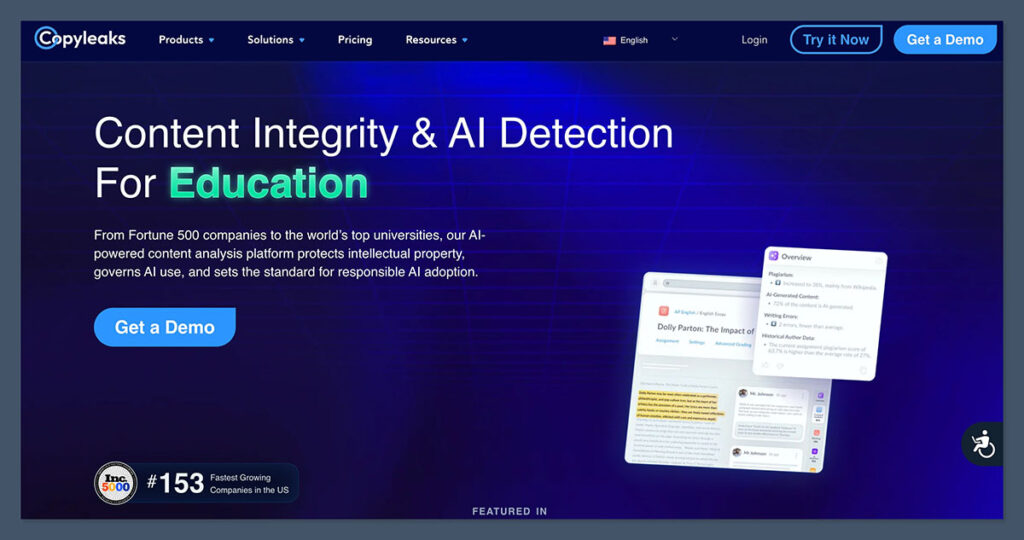
The students most likely to be wrongly accused are the ones writing in their second language. Seven commercial detectors misclassified TOEFL essays by non-native speakers 61.3% of the time on average, per Liang et al. in Patterns (2023). Copyleaks posted the lowest ESL false-positive rate of the majors in CoGrader’s analysis, around 13%, against 18% for Turnitin and 38% for GPTZero.
Pricing
Free tier of about 10 pages a month (roughly 2,500 words), two concurrent scans.
- Essential from $8.99/month, 100 pages
- Personal $13.99/month annually, 1,200 credits or roughly 300,000 words
- Pro $74.99/month annually, 25 seats and 12,000 credits
- Education custom-quoted, no published figure
False-positive risk: Moderate
Copyleaks markets roughly 0.2%, and no third-party benchmark supports it. AIMultiple measured 11% false positives on human text alongside a perfect 100% AI-detection score. Other estimates land at 1 to 2%. Plan around 11%.
Key Features
- LMS integrations for Canvas, Moodle, Blackboard, Brightspace and Schoology, the widest roster here
- AI detection and plagiarism checking in one report
- Support for 30+ languages
- Batch and class-level scanning
- SOC 2 compliance for institutional procurement
Pros ✔️
- Lowest measured ESL false-positive rate among the major detectors
- Perfect AI-detection score in AIMultiple’s independent test
- Fits an existing gradebook workflow, not a separate copy-paste task
Cons ❌
- The 11% human-text result sits nowhere near the marketed 0.2%
- Thin free tier at roughly 2,500 words a month, about two essays
- Education pricing is quote-only, so there is no number for a budget
What independent testing shows
Copyleaks caught 100% of AI text and flagged 11% of human text in the same test, the sensitivity-versus-fairness tradeoff in one line. CoGrader weighted false positives at 25% and bias against non-standard writing at 20%, a weighting we share, because that bias tracks perplexity (how predictable the prose is) rather than authorship.
The verdict: the best AI detector for essays in a multilingual classroom, as long as you treat 11% as a reason to verify before you accuse.
2. GPTZero: Best Free Tier for Individual Teachers
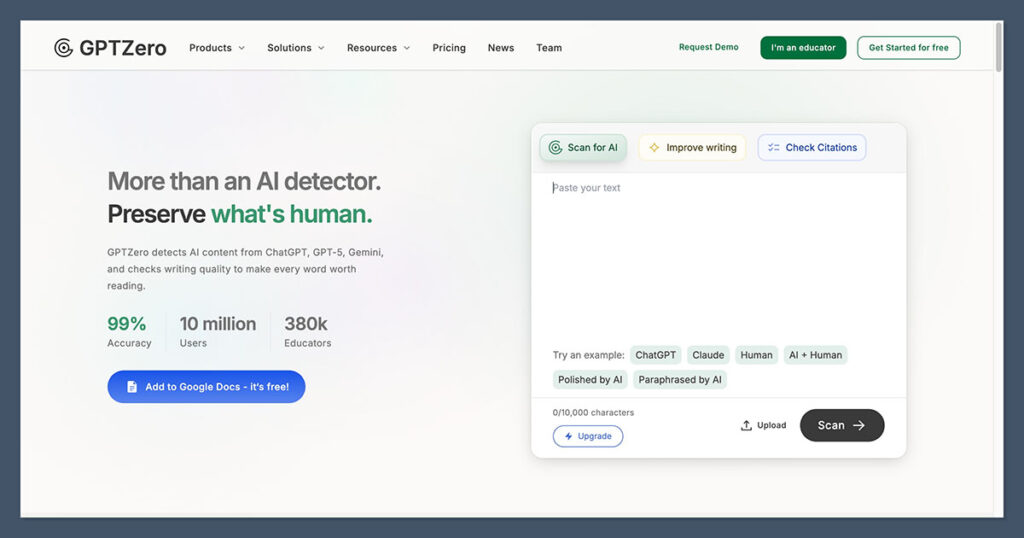
Roughly 10,000 words a month free, no purchase order, and sentence-level color-coded highlighting. Instead of walking into a conversation holding a percentage, you walk in with paragraphs to ask about.
Pricing
Free tier of around 10,000 words a month; premium around $12.99/month per secondary sources; team and enterprise quoted.
- A transparency problem: GPTZero’s own pricing page shows no dollar figures and no accuracy percentage
False-positive risk: Moderate overall, High for ESL writers
GPTZero claims it detects 95.7% of AI texts while misclassifying 1% of human texts on the RAID benchmark (672,000 texts, 11 domains, 12 attack types). Independent results pull the other way. Scribbr’s 2024 test found it identified only 52% of texts correctly, CoGrader put its ESL false-positive rate near 38% and its humanized-content accuracy at 46.7%, and one test flagged a fully human article at 55% AI.
Key Features
- Sentence-level highlighting showing which passages are suspected
- Official AI detector partner of the American Federation of Teachers
- Claims 10M+ teacher and student users across 100+ countries
Pros ✔️
- A genuinely usable free tier, the realistic no-budget starting point
- Sentence-level evidence rather than a single number
- Sub-1% false positives in the Chicago Booth audit, holding 96% accuracy on short passages
Cons ❌
- The widest claim-versus-test gap here: 95.7% claimed against 52% measured by Scribbr
- Worst ESL false-positive rate of the majors at roughly 38%
- Named in false-accusation lawsuits at Yale and the University of Minnesota
- Opaque pricing on its own page
What independent testing shows
Both sets of verdicts are real. RAID and Chicago Booth are large, careful studies where GPTZero does well; Scribbr and CoGrader are equally real, and it does badly there. The difference is methodology: clean benchmark corpora versus mixed real-world and humanized text. Student writing looks like the second, so treat a flag as a prompt to look, never as a finding.
Best for the teacher who needs a free AI detector for essays specific enough to start a conversation. Skip if your class is largely ESL.
3. Turnitin: Best If Your Institution Already Licenses It
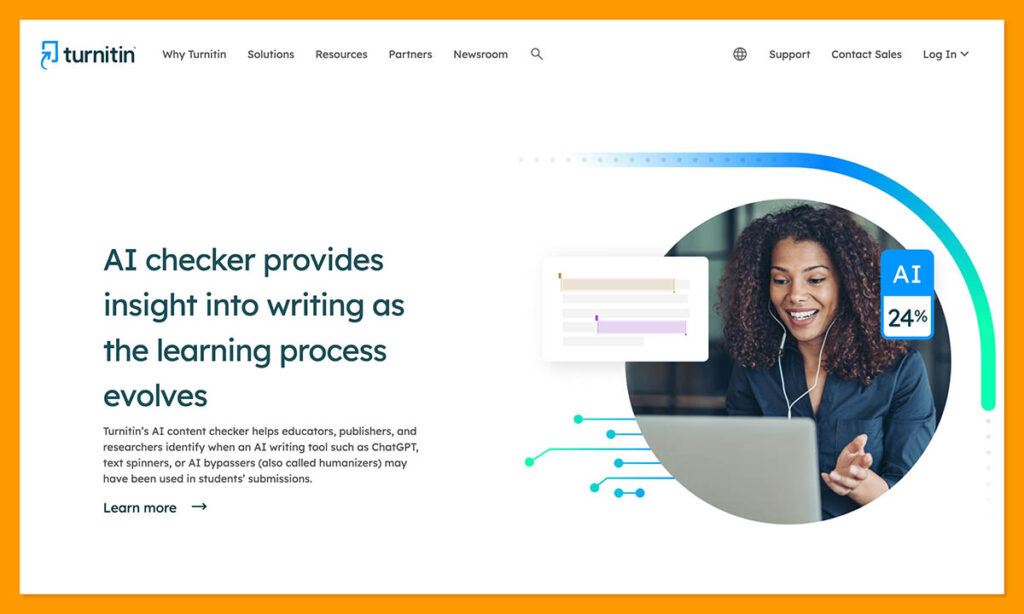
Turnitin’s under-1% false-positive claim only applies to documents its model scores above 20% AI-written. Below that line it suppresses the percentage and asterisks the result as less reliable, never disclosing the error rate for those documents. No top-ranking guide for this search reviews Turnitin at all, despite it being the detector most teachers have.
Pricing
No public consumer pricing. Institution-only licensing, bundled with the plagiarism and similarity suite.
- The practical consequence: an individual teacher cannot buy Turnitin
False-positive risk: Moderate to High, and unmeasurable below a 20% score
Turnitin claims under 1% above that threshold. A 2024 study in Computers and Education found it flagged AI text correctly 91% of the time while carrying a 4.2% false-positive rate on human writing. CoGrader measured roughly 18% on ESL writing.
Key Features
- Already deployed at most institutions, so no new tool or budget line
- Runs inside the Canvas submission workflow, with a per-student dashboard score
- Bundled with similarity and plagiarism reporting
Pros ✔️
- Zero adoption friction wherever it is already licensed
- The vendor sets the right expectation: Chief Product Officer Annie Chechitelli calls the score a way to “start a meaningful and impactful dialogue.”
- Suppressing low scores beats a precise but unreliable number
Cons ❌
- The headline claim is contradicted by peer review: under 1% against 4.2% measured
- Roughly 18% ESL false-positive rate
- 12+ institutions have disabled or paused it as of March 2026, including Vanderbilt, Michigan State and Northwestern
- Repeatedly at the center of overturned cases: a judge in Newby v. Adelphi voided a finding built on a contradicted 100% flag as “without valid basis and devoid of reason”
- Opaque methodology, the complaint Vanderbilt made and Maryland’s Soheil Feizi repeats
What independent testing shows
Turnitin switched the detector on with under 24 hours’ notice and no opt-out. Vanderbilt did the arithmetic instead of accepting it: 1% of 75,000 annual submissions is roughly 750 wrongly flagged papers a year. And 1% is the vendor’s optimistic figure. The 4.2% peer review found would be more than 3,000 papers.
If it is already in your gradebook, treat it as triage above 20%, ignore the asterisked scores, and never open a case on the number alone. For a Turnitin alternative, Copyleaks has the better ESL record and Originality.ai the lower measured false-positive rate.
4. Originality.ai: Best for Bulk Scanning With Plagiarism Included
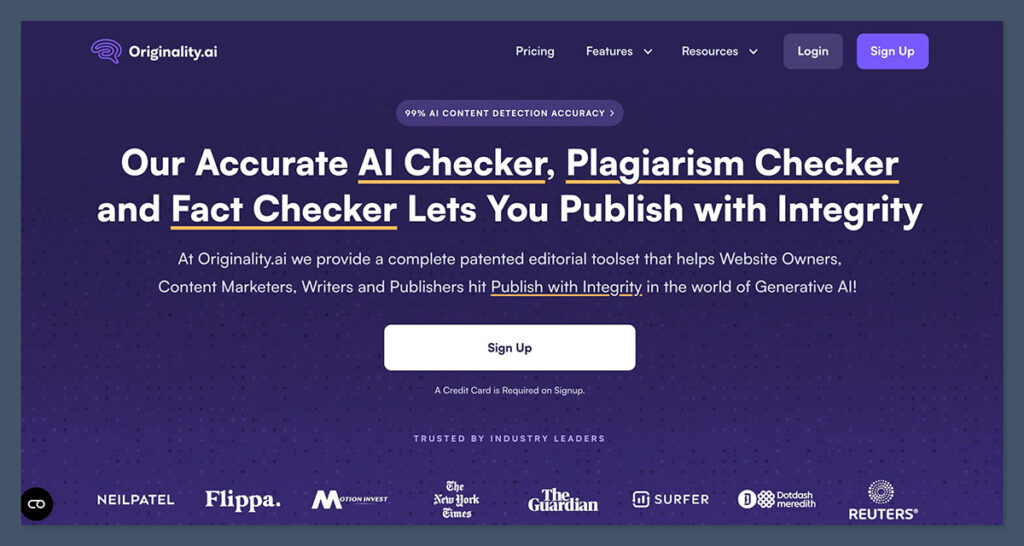
One of the articles competing for this search is published by Originality.ai and ranks Originality.ai first. That does not make the tool bad. The interesting question is what independent studies found: a genuinely low false-positive rate paired with a miss rate its marketing skips.
Pricing
Pro $12.95/month billed annually ($14.95 monthly), 2,000 credits a month, where one credit covers 100 words.
- Enterprise $136.58/month annually ($179 monthly), 15,000 credits and a dedicated success manager
- No free tier and no education tier, despite Duke, Purdue and Harvard logos on the site
False-positive risk: Low. False-negative risk: High
Chicago Booth measured under 1% false positives, matching GPTZero, but false negatives of 10 to 40% depending on which LLM wrote the text. AIMultiple found it caught all ChatGPT and DeepSeek output and missed Gemini entirely. Scribbr’s 2024 test rated it the most accurate tool measured, at 76%.
Key Features
- Bulk scanning built for volume
- Plagiarism detection bundled with AI detection
- API access for programmatic checking
Pros ✔️
- Under 1% false positives in the only large independent audit covering it
- Bulk plus plagiarism in one pass, which no free tool here offers
- Transparent published pricing, unlike GPTZero, Turnitin or any education tier here
Cons ❌
- Misses 10 to 40% of AI text by source model, and missed Gemini entirely in AIMultiple’s test, so a clean score proves little
- No free tier to trial before committing
- No education pricing despite education-facing marketing
- The vendor publishes a competing ranking of this exact keyword
What independent testing shows
A tool that rarely accuses the innocent but often waves the guilty through is the safer failure mode when the cost lands on a student’s record. That holds only if you know you are buying screening, not proof.
Against GPTZero: both cleared under 1% false positives in the Chicago Booth audit, GPTZero starts free and shows sentence-level evidence, and Originality.ai answers with bulk scanning, bundled plagiarism checking and published pricing.
5. Scribbr: Best Free Check With No Signup
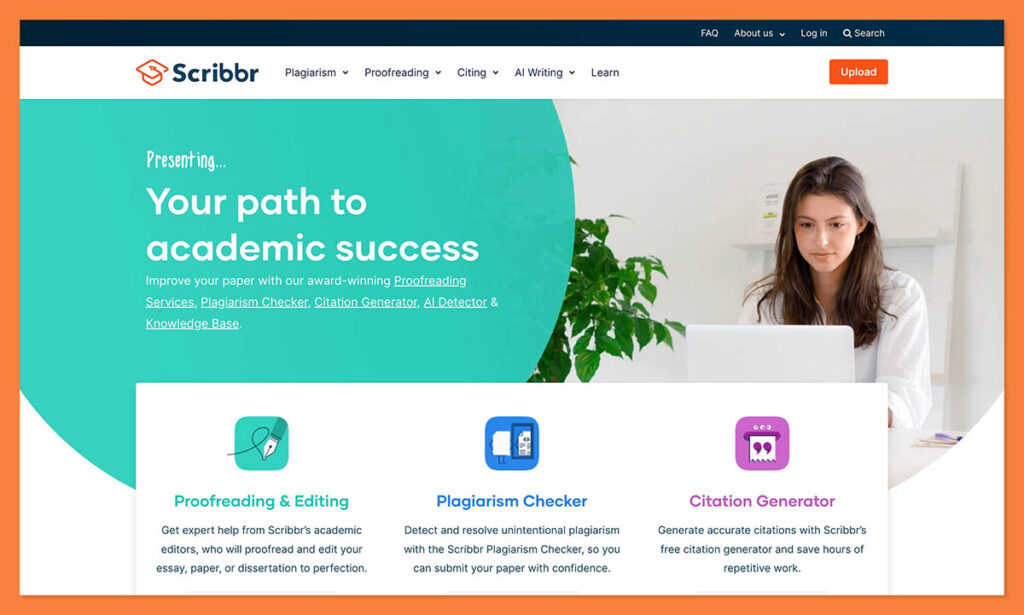
Paste, scan, done. No account, no card, no word budget to ration, which makes it the right tool for the check you would otherwise skip.
Pricing
Free, no signup required. It sits inside Scribbr’s wider academic writing toolset.
False-positive risk: Low, but detection is weak
AIMultiple measured a 6% false-positive rate alongside 69% AI-detection accuracy, one of the better fairness showings among free tools. Pangram’s 30-tool comparison scored its detection at only 44%, though that test is vendor-run. Several sources report it degrading badly on paraphrased text.
Key Features
- No account or payment required at any point
- Simple paste-and-scan interface with nothing to configure
- Positioned for academic writing rather than marketing copy
- Useful as a second opinion when another tool flags something
- Scribbr publishes its own comparative tests of rival detectors
Pros ✔️
- Zero friction, which in practice means you will actually use it
- Low measured false-positive rate at 6%, better than several paid tools
- Useful as a disagreement test, since two tools disagreeing is itself a finding
Cons ❌
- Catches under half to two thirds of AI text, so a human verdict means little
- Falls apart on paraphrased text
- Not arm’s-length, since Scribbr tests rivals and sells its own academic tools
- No LMS integration or batch checking
What independent testing shows
The 6% false-positive figure is why it earns a slot. The 44 to 69% detection range is why it cannot be the only tool you use.
The verdict: the right free tool for a quick second opinion, and the wrong one for a first-and-only opinion.
6. QuillBot: Best Free Sentence by Sentence Breakdown
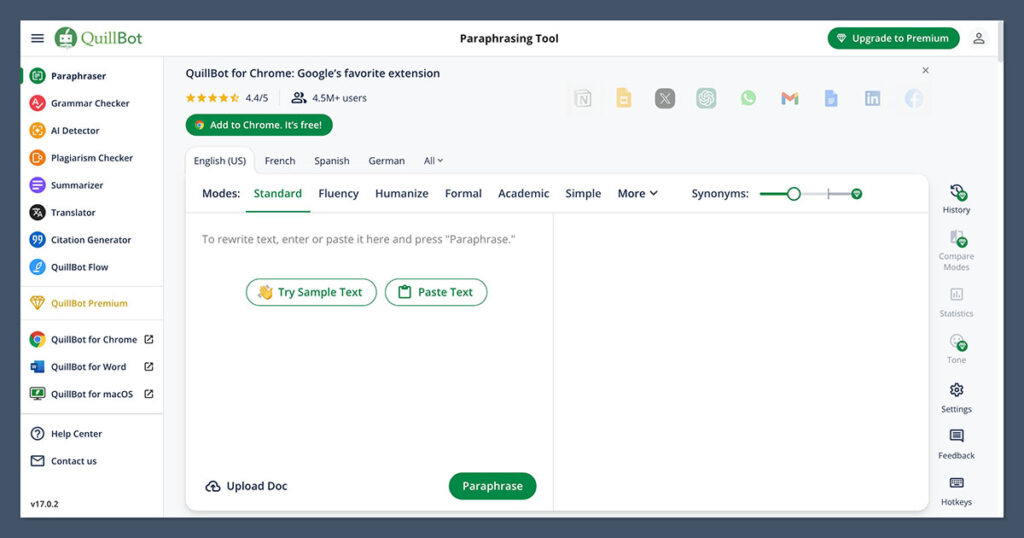
In independent testing, QuillBot’s Humanizer took a passage its own detector rated 88% AI down to 0%, and the rewritten text also passed GPTZero. The same company sells both sides of that transaction, and no competing ranking mentions it.
Pricing
Free tier of up to 1,200 words per scan, six scans a day, limited explainer cards and one free rewrite card.
- Premium removes the word and scan limits and unlocks full explainers
False-positive risk: Low. Miss rate: the real problem
QuillBot cites a 99% detection rate “according to independent evaluations,” from the RAID benchmark. Nothing found here supports it: 44% detection in Pangram’s 30-tool test, up to 78% in another, and AIMultiple found it missed all Gemini text for a 49% false-negative rate.
Key Features
- Sentence-by-sentence breakdown rather than a document score
- Explainer cards describing why a sentence was flagged
- Free to use without an institutional license
- Part of a toolset most students already use
Pros ✔️
- Per-sentence granularity when you need to point at something specific
- Generous free daily allowance for occasional checking
- Does not appear to over-flag human writing in tests reviewed here
Cons ❌
- Direct conflict of interest: the detector routes flagged users to QuillBot’s own Humanizer and Paraphraser
- The 99% figure is unsupported by any test found here
- Missed all Gemini output in AIMultiple’s benchmark
What independent testing shows
Several tools marketed as detectors also sell humanizers: QuillBot, Phrasly, Undetectable AI, Monica, Humalingo. Paperpal sits in the same structure, an AI writing suite that also grades AI writing. A vendor earning on both sides of the arms race has no reason to win it.
Best for free per-sentence reading of one essay. Skip if you need a reliable signal an essay is clean.
7. Winston AI: Best for Formal Report Documentation
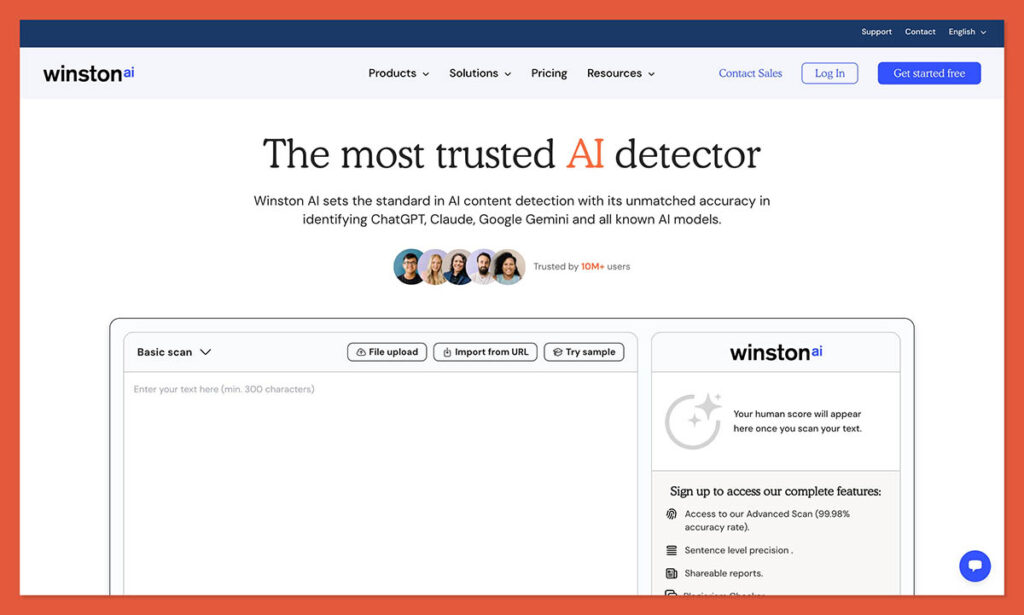
At the 8 to 10% real-world false-positive rate independent reviewers cite for Winston, a single 30-essay assignment would be expected to produce two or three wrongly flagged students. Run that across a semester and the arithmetic starts to look like Vanderbilt’s.
Pricing
Free tier of 2,000 credits on a 14-day trial.
- Essential $18/month, or $10/month annually, 100,000 credits
- Advanced $29/month, or $16/month annually, 200,000 credits
- Elite $49/month, or $26/month annually, 500,000 credits
- Education and enterprise by “contact us” only, no published tier
False-positive risk: High
The widely quoted 99.98% accuracy figure appears nowhere on Winston’s own pricing page. Independent figures in secondary sources put real-world false positives at 8 to 10%, with a 20 to 28% false-negative rate on Claude-generated text.
Key Features
- Professional PDF report generation aimed at formal documentation
- OCR, so it reads scanned and handwritten submissions
- Bundled plagiarism detection
- Image and deepfake detection alongside text
Pros ✔️
- Exportable reports, the one thing here designed for an integrity file
- OCR on handwritten and scanned work, genuinely rare among detectors
- Steep annual discounts, cutting Essential from $18/month to $10
Cons ❌
- Weakest independent showing of any major paid tool here, at 8 to 10%
- The 99.98% claim is unverified and absent from the vendor’s own pricing page
- Misses 20 to 28% of Claude-generated text
- No published education pricing
What independent testing shows
The tool best suited to documenting an accusation has the weakest independently cited case for that accusation being right. A Winston PDF records the process you followed. It does not replace following one.
Use it for OCR on handwritten work and for record-keeping alongside a lower-false-positive tool, not as the detector that decides anything.
8. ZeroGPT: The Popular Free Tool to Approach With Caution
Permanently free, no card required, and one of the most-used detectors on the open web. In one independent comparison it flagged two out of every three human-written texts as AI.
Pricing
Free tier permanently available, no credit card.
- Paid tiers exist but carry no published prices, and the page states no accuracy figure while marketing the tool as the most advanced and reliable available
False-positive risk: High and inconsistent
AIMultiple measured 41% AI-detection accuracy with 0% false positives in its sample. Pangram’s 30-tool test measured 67% detection with a 67% false-positive rate on human text. ZeroGPT publishes no accuracy figure of its own to check either against.
Key Features
- Free forever, no account required
- Fast and simple, one paste-and-scan box
- Widely linked, which is how most teachers find it
Pros ✔️
- Costs nothing, ever, with no trial clock
- No signup friction at all
- Posted 0% false positives in one of the two independent tests found
Cons ❌
- Lowest detection accuracy in this ranking at 41%
- 67% false-positive rate on human text in the other independent test
- No published accuracy claims on its own site
- No educator features at all
What independent testing shows
Two independent tests produced opposite fairness results on the same tool, and that instability is the finding. A detector that posts 0% false positives in one sample and 67% in another is not measuring anything you can plan around.
If you want a free AI checker for student essays, use Scribbr for the low false-positive rate or GPTZero for the sentence-level detail. There is no scenario where ZeroGPT beats those two for a teacher.
How the 8 AI Essay Detectors Compare
Ranked by wrongful-flag risk first, workflow second, headline accuracy last.
| Detector | Best for | Free tier | Paid from | Vendor accuracy claim | Independently tested false positives | Educator workflow |
|---|---|---|---|---|---|---|
| 1. Copyleaks | LMS + multilingual | ~10 pages/mo | $8.99/mo | ~0.2% | 11% (AIMultiple) | Canvas, Moodle, Blackboard, Brightspace |
| 2. GPTZero | Solo teachers | ~10,000 words/mo | ~$12.99/mo | 95.7% detection at 1% FPR | <1% general, ~38% ESL | Education-focused, LMS |
| 3. Turnitin | Schools already licensed | None | Institution only | <1% above a 20% score | 4.2% (2024 study), ~18% ESL | Native inside Canvas |
| 4. Originality.ai | Bulk + plagiarism | None | $12.95/mo annual | None on pricing page | <1% (Chicago Booth) | Bulk and API, no LMS |
| 5. Scribbr | 60-second free check | Unlimited, no signup | Free only | None published | 6% (AIMultiple) | None |
| 6. QuillBot | Per-sentence reading | 1,200 words, 6 scans/day | Premium, unlisted | 99% detection | None published; 49% miss rate | None |
| 7. Winston AI | Reports and OCR | 2,000 credits, 14 days | $10/mo annual | 99.98% | 8 to 10% (secondary) | Reports, no LMS |
| 8. ZeroGPT | Not recommended | Unlimited free | Not published | None published | 0% to 67% by test | None |
None of these tools produces proof. The distance between the vendor claim column and the tested column is why.
What to Do When a Detector Flags an Essay
No competing guide for this search gives an educator a procedure. Here is one.
- Never act on the score alone. Turnitin’s own guidance says its model “should not be used as the sole basis for adverse actions against a student,” and Michigan State’s position is identical. A New York court agreed in Newby v. Adelphi, voiding a finding built on a contradicted 100% flag as “without valid basis and devoid of reason” and ordering the record expunged.
- Run a second detector first. If two tools disagree, you have no case. Law professor David Bernstein ran his daughter’s non-AI college application essay through two detectors: 95.6% confident AI from one, 0% from the other.
- Ask for the version history. UC Davis student Louise Stivers cleared a two-week investigation with timestamped Google Docs revision history. Make it a standing requirement on every assignment rather than a demand made under suspicion, so it is evidence the student already has.
- Compare against the student’s earlier work for consistency in style, tone and quality, which is Vanderbilt’s own faculty guidance. Then check the citations, because a fabricated source is far stronger evidence than any percentage.
- Talk to the student before you escalate. Turnitin’s Chief Product Officer describes the score as a way to start a conversation rather than a verdict, and that is the vendor talking about its own product.
- Check your policy and document your process before a case is opened, not after. Weigh the ESL and neurodivergent risk explicitly: Adelphi separately disciplined an autistic student whose handwritten essay was flagged at 100%, and non-native writers face a documented 61.3% mean false-positive rate.
How We Ranked These Detectors
The evidence standard behind the order above:
- Independently tested false-positive rate weighted heaviest, echoing CoGrader’s 25% false positives, 20% bias against non-standard writing, 20% humanizer resilience, 15% workflow
- Vendor claims recorded but never used to rank, sources named: Chicago Booth, Liang et al. (Patterns, 2023), Scribbr 2024, AIMultiple, RAID and court records
- Educator workflow judged on LMS integration, batch checking and no-purchase-order access
- Pricing verified against official pages in July 2026 and dated, because free-tier limits move
Three tools were excluded deliberately. Humalingo tops two competing rankings: it carries a 65/100 trust score from one scam-checking service, Trustpilot reviewers document a $2 trial converting to roughly $40 charges with refused refunds, and its own detector flagged fully human text at 93% AI.
Proofademic has no large-scale independent benchmark behind its 99.8% claim. Paperpal has no published accuracy figure or third-party validation, and is made by a company publishing a competing ranking that places it first. We take no affiliate commission on anything listed here.
AI Detectors for Essays: Frequently Asked Questions
The questions that come up once you have picked a tool.
How accurate are AI detectors for essays, really?
Not accurate enough to treat as proof. AIMultiple’s benchmark found detectors identified about 88% of human-written content correctly but only 71% of AI text. Detecting ChatGPT in essays was the easy case at 87%, while Gemini-generated writing dropped to 54%. OpenAI shut down its own classifier in July 2023 after it caught just 26% of AI text while flagging 9% of human text. The company that builds the models could not reliably detect them.
Are non-native English speakers more likely to be falsely flagged?
Yes, and it is the most robustly documented bias in the field. Liang et al. (Patterns, 2023) found a 61.3% mean false-positive rate when seven commercial detectors ran on TOEFL essays by non-native speakers, against near-perfect accuracy on native-speaker essays. The cause is linguistic complexity, not authorship. Raising the vocabulary level of those same essays cut misclassification to 11.6%, while simplifying native-speaker essays raised theirs.
Can I discipline a student based on an AI detection score?
No responsible policy allows it, and courts are starting to say so. Turnitin’s own guidance says its score should not be the sole basis for adverse action, and Michigan State says the same. In Newby v. Adelphi, a New York judge ordered a finding expunged as “without valid basis and devoid of reason” where a single 100% Turnitin flag was contradicted by two other detectors. Check your institution’s written policy first.
Can students beat AI detectors with humanizer tools?
Routinely. Independent testing showed QuillBot’s Humanizer, Monica’s and Phrasly.AI’s all reducing clearly AI-generated text to a 0% AI score that also passed GPTZero. That creates an asymmetry worth understanding. A student willing to pay for a humanizer usually evades detection, while an honest student with a plain, predictable style has no way to avoid being flagged.
Why do two detectors give completely different scores on the same essay?
Because they use different training data and different thresholds, and most compress a spectrum into one number. Law professor David Bernstein ran his daughter’s non-AI college application essay through two detectors and got 95.6% confident AI from one and 0% from the other. Disagreement between tools is not a tiebreak to resolve. It is evidence that neither score is reliable enough to act on.
Do detectors work on essays that mix AI and human writing?
Poorly, and that is where most real student work now sits. CoGrader’s analysis put GPTZero’s accuracy on humanized content at 46.7%, and Turnitin suppresses any score under 20% as less reliable. Some detectors now offer an explicit “AI-assisted” category rather than forcing a binary verdict, which is the more honest model. For blended work, process evidence such as version history beats any score.
Should schools use AI detection at all?
Experts split. University of Maryland’s Soheil Feizi argues detection is unreliable enough that schools should teach AI use rather than police it, calling acceptable accuracy “impossible” at present. Vanderbilt disabled Turnitin’s detector and moved faculty toward in-class writing, current-event prompts, required AI-use disclosure and comparison against prior work. The workable middle ground is detection as one signal inside a process, never as the process.