Whether you’re in academia, biotech, or still finishing your chemistry degree, AI is now a part of modern chemistry workflows.
From retrosynthesis to reaction prediction and virtual screening, there’s a growing set of tools that can make chemistry faster, smarter, and more accessible.
I’ve personally tested and reviewed the leading AI tools being used across synthetic chemistry, literature search, molecular modeling, and lab automation.
Based on that, here are my top recommendations.
Quick Comparison: Top AI Tools for Chemistry
| Tool | Best For | Price | AI Capabilities | Access |
|---|---|---|---|---|
| IBM RXN | Retrosynthesis & reaction prediction | Free | Predicts reaction outcomes and generates procedures | Web |
| SYNTHIA | Commercial retrosynthesis | Custom pricing | Compares synthetic routes | Web |
| CAS SciFinder | Literature and reaction database | License required | AI-assisted search & curation | Web |
| Schrödinger | Property prediction and modeling | Starts at $15,000/year | Advanced AI screening tools | Web/Desktop |
#1. IBM RXN for Chemistry: Best Free Retrosynthesis Tool
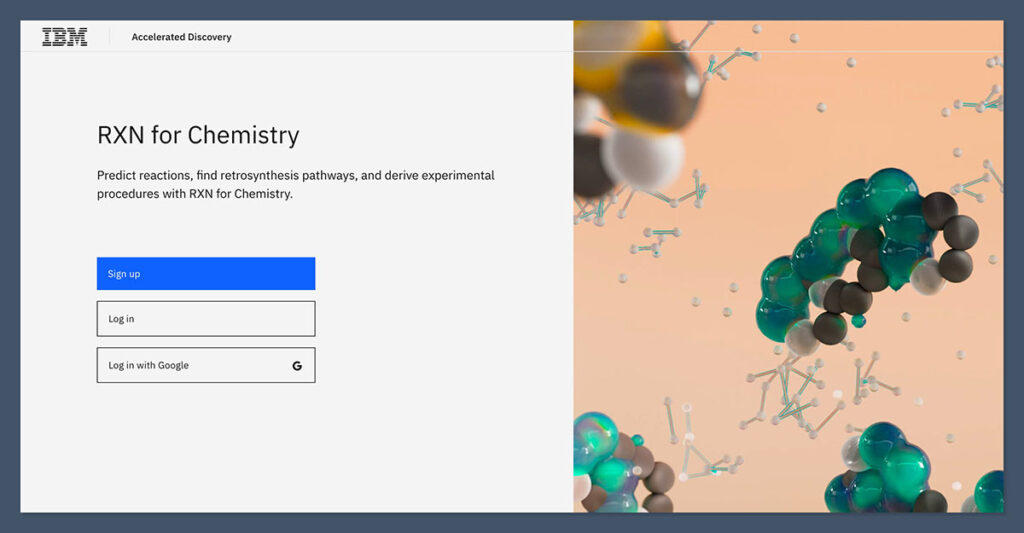
IBM RXN is my top pick if you’re looking for a free, reliable tool that supports retrosynthesis, reaction prediction, and automated experimental procedures. It feels like having a lab assistant that never gets tired.
Why I Recommend It
- You can input molecules and get retrosynthetic routes in minutes
- The system uses deep learning to mimic how chemists think
- You can convert retrosynthetic paths into lab-ready protocols
IBM RXN is ideal for both students learning synthesis and professionals running real drug design projects. And because it’s entirely browser-based, there’s no software to install.
Pros
- Completely free
- Predicts outcomes with high accuracy
- Converts plans into experimental steps
Cons
- Limited customization of routes
- Some outputs lack mechanistic explanation
Price
Free to use
#2. SYNTHIA: Best for Route Comparison in Industry
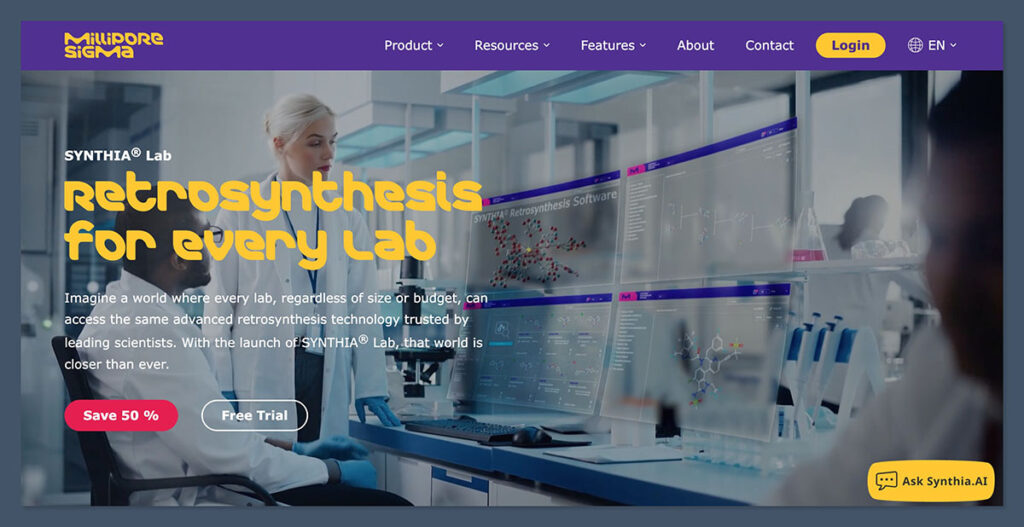
SYNTHIA, formerly Chematica, is a commercial-grade retrosynthesis platform used by major pharma companies. Unlike other tools, it compares multiple synthetic routes, highlighting costs and feasibility.
Why I Recommend It
- Helps you select the best route, not just any route
- Built-in risk scoring for scale-up
- Used by Pfizer, Merck, and top CROs
SYNTHIA stands out for its ability to weigh synthetic options like a human chemist. You can enter a target molecule and compare up to 10 viable pathways, each with literature references.
Pros
- Enterprise-grade retrosynthesis
- Highlights cost, complexity, and practicality
- Trusted by drug discovery teams
Cons
- Expensive
- Not open-source
Price
Custom pricing (starts around $5,000 per seat)
#3. CAS SciFinder: Best for Literature & Reaction Search
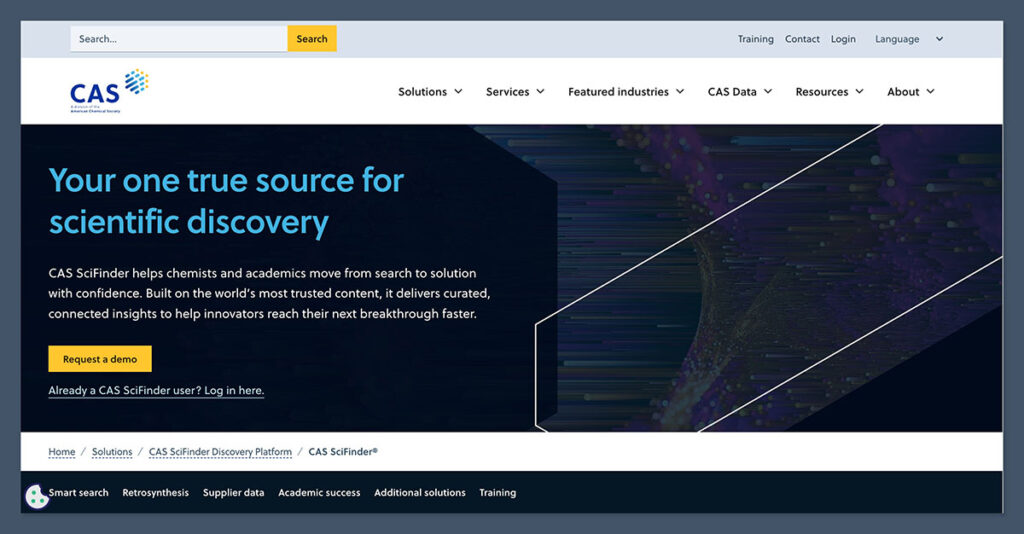
SciFinder is a chemistry-first research platform used by students, educators, and pharma companies. The platform now includes AI tools to accelerate literature discovery and chemical insights.
Why I Recommend It
- Search for molecules, reactions, and patents in seconds
- AI suggestions help uncover relevant data you might miss
- Great for students working on review papers or presentations
When I was mentoring a group of undergrads last year, SciFinder helped them complete three weeks’ worth of paper research in about two days. The tool does a lot of the heavy lifting in background reading.
Pros
- Covers over 130 million reactions
- Includes patent and substance data
- AI recommends related reactions
Cons
- Requires institutional license
- No synthesis tools included
Price
Available via academic and corporate licenses
#4. Schrödinger Platform: Best for Molecular Modeling
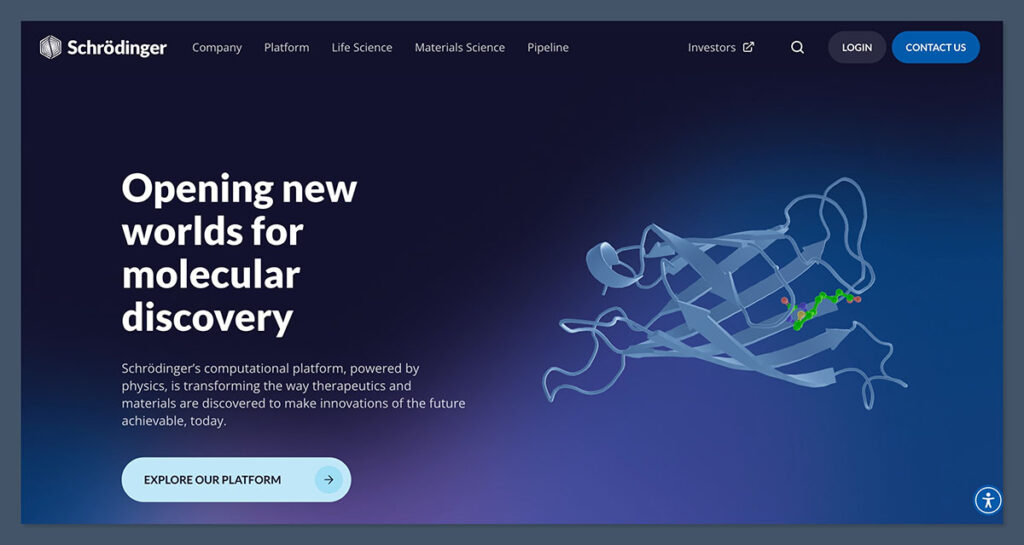
Schrödinger is the top platform for property prediction, docking studies, and virtual screening. If your chemistry involves computational drug design, this is the tool most teams rely on.
Why I Recommend It
- Simulates molecule behavior before synthesis
- Supports ADME prediction, toxicity, and optimization
- Used by companies like Bristol Myers Squibb and Eli Lilly
Its integration with LiveDesign allows chemists and biologists to work collaboratively. Schrödinger is expensive but offers unmatched capabilities in property modeling.
Pros
- Gold-standard in computational chemistry
- Wide range of simulation tools
- Supports enterprise R&D collaboration
Cons
- High cost
- Learning curve for beginners
Price
Starts at $15,000 per user per year
More Tools to Explore
Here are other AI tools worth checking out, depending on your use case:
| Tool | Best For | Price | Access |
|---|---|---|---|
| DeepChem | Open-source ML in chemistry | Free | GitHub |
| RDKit | Cheminformatics backbone | Free | GitHub |
| Reaxys AI Search | Literature & data mining | License | Explore Reaxys |
| Benchling AI | Lab automation and ELNs | Enterprise pricing | Benchling |
| Bruker TopSpin | NMR spectral interpretation | License | Bruker AI |
| Elicit | AI literature reviews | Free + paid | Try Elicit |
| scite.ai | Smart citation analysis | $120/year | Visit scite |
Top 3 AI Chemistry Toolkits for Different Roles
Here’s how I’d recommend building your AI toolkit based on your background or career stage.
Students and New Researchers
Free, easy-to-use tools to build skills
- IBM RXN
- RDKit
- Elicit
Synthetic Chemists
Retrosynthesis and reaction data at your fingertips
- IBM RXN
- Reaxys
- SYNTHIA
Industry R&D Teams
Full-stack platforms for advanced workflows
- Benchling AI
- SciFinder
- Schrödinger
Final Thoughts
The best AI tools for chemistry aren’t just smart, they’re practical. Whether you’re automating lab work, predicting new compounds, or mining the literature, these platforms help you move faster with more confidence.
I’ve tested each of these tools hands-on, and the key takeaway is that AI in chemistry isn’t a future trend, it’s already transforming how chemists work today.
From students to large pharmaceutical teams, there’s a tool for everyone.